· Alex Derville · 8 min read
Flexitarian vs Pescatarian: A Simple Guide to Plant-Forward Diets
Choosing a plant-forward way of eating? Flexitarian and pescatarian sit between omnivore and vegetarian or vegan. Here is how they compare, where they fit on the spectrum, and how to pick what works for you.

More people want to eat fewer animal products without committing to a fully vegetarian or vegan plate overnight. That middle ground is where plant-forward diets live: you still decide how much meat, fish, dairy, and eggs show up day to day, but plants move to the center.
Two patterns you will see everywhere are flexitarian (mostly plants, flexible rules) and pescatarian (no land-animal meat, fish and seafood allowed). They are not opposites; they are different stopping points on the same path. This guide is for anyone still choosing a style, not only for people comparing two labels in a vacuum.
If you want definitions for every major label (omnivore, vegan, pollotarian, climatarian, and more), start with our full reference: Defining dietary patterns. Here we stay focused on the spectrum between omnivore and vegetarian or vegan, with flexitarian and pescatarian in the middle.
Comparing flexitarian to a restrictive whole-food pattern instead? See Flexitarian vs paleo diet.
The main plant-forward diets at a glance
| Diet | Main idea | Includes | Excludes |
|---|---|---|---|
| Omnivore | No dietary restriction | Meat, fish, dairy, eggs, plants | Nothing by definition |
| Flexitarian | Mostly plant-based, flexible | Plants, occasional meat, sometimes fish | Nothing strict |
| Pescatarian | No meat from land animals | Plants, fish, seafood; often dairy and eggs | Red meat, poultry, game |
| Vegetarian | No meat or fish | Plants, dairy and/or eggs | Meat and fish |
| Vegan | No animal products | Plants only | Meat, fish, dairy, eggs, honey |
The label matters less than what actually lands on your plate week after week. Flexitarian is usually the loosest; pescatarian follows a clear rule (no land-animal meat) that is easy to explain to others.
What is a flexitarian diet?
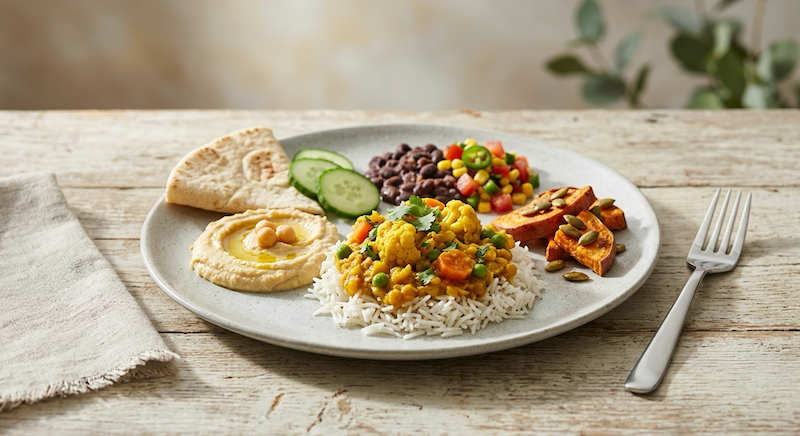
A flexitarian diet is centered on plants but does not require you to eliminate meat, fish, or other animal foods. People often pick it because it feels realistic and gradual: family dinners, restaurants, travel, and picky eaters all stay manageable.
A flexitarian typically eats:
- Vegetables, fruit, legumes, grains, nuts, and seeds most of the time
- Dairy and eggs, depending on preference
- Meat occasionally, in small amounts or on certain days
- Fish sometimes, depending on habit
There is no single official frequency for “occasional” meat. That can make the word mean slightly different things from one person to another. For many, that ambiguity is a feature: you can reduce meat without feeling locked into a rigid identity. If you like structure, you can still set your own rules (for example, three meatless days a week) and tighten them over time. The full diet-type guide includes example plate splits and beginner-to-advanced flexitarian levels.
What is a pescatarian diet?
A pescatarian diet drops meat from land animals but keeps fish and seafood as animal protein. People often choose it when they want a clear boundary (“no chicken or beef”) without giving up seafood, or when they see fish as an easier protein to keep in rotation than land meat.
A pescatarian typically eats:
- Vegetables, fruit, legumes, grains, nuts, and seeds
- Fish and shellfish
- Often dairy and eggs
- No beef, pork, lamb, poultry, or other land-animal meat
Compared with flexitarian, pescatarian is easier to define: either something is land meat or it is not. That can simplify meal planning and grocery lists. The trade-off is a stricter line when you eat out, travel, or share a kitchen with people who default to meat-centered meals. For official-style guidance on seafood amounts, see the pescatarian section of the main explainer.
Flexitarian vs pescatarian: the core difference
In one sentence: flexitarian can include occasional land-animal meat; pescatarian cannot.
- Flexitarian is broader and easier to phase into. Some weeks look almost vegetarian; other weeks still include a burger or roast chicken.
- Pescatarian is narrower and more predictable: fish yes, land meat no.
So a flexitarian might eat like a pescatarian on many days, but the reverse is not true. A pescatarian who eats chicken even once is not pescatarian anymore by the usual definition; a flexitarian who never eats land meat is behaving like a pescatarian even if they still call themselves flexitarian.
Where they fit on the diet spectrum
A useful mental model is a single spectrum of how many animal products you eat, not five unrelated “clubs”:
Omnivore → Flexitarian → Pescatarian → Vegetarian → Vegan
That order is not a judgment. It is a map. Flexitarian usually sits closest to omnivore (still room for meat, just less). Pescatarian sits closer to vegetarian than flexitarian does, because land meat is off the table but fish remains.
In real life, people often move gradually: omnivore to flexitarian first, then maybe pescatarian or vegetarian if a clearer rule feels right. You can also stay flexitarian for years and never “graduate.” What matters is whether your pattern matches your health, ethics, and sustainability goals. For vegetarian vs vegan and emissions numbers across diets, the comparison section in the main guide is the right next read.
Health and nutrition
Both flexitarian and pescatarian patterns can be healthy when they are built around whole foods (vegetables, legumes, whole grains, nuts, seeds, fruit) rather than ultra-processed substitutes for every meal.
Pescatarian diets often include seafood more regularly, which can be a steady source of protein and omega-3 fatty acids, depending on which fish you choose. Flexitarian eating can swing more from week to week, so consistency matters: if meat-heavy weeks alternate with mostly plant weeks, average nutrition looks different than if you are “flexitarian” but still eat large portions of processed meat often.
Either way, it is worth paying attention to:
- Protein (plants, fish, dairy, eggs, or modest meat on flexitarian plans)
- Iron (plants + absorption helpers like vitamin C)
- Vitamin B12 (animal foods or fortified foods and supplements on stricter plant-heavy patterns)
- Omega-3 fats (fatty fish for many pescatarians; algae or seeds for others)
- Iodine, calcium, and zinc, especially if dairy is low
If you have medical conditions or are pregnant, a registered dietitian can tailor this to you; this article is general education, not medical advice.
Environmental impact
Both patterns usually have a lower footprint than a meat-heavy omnivorous diet, especially when they cut beef and other high-impact meats. How much lower depends on how often meat still appears (flexitarian) and which seafood you buy, how it was caught or farmed, and how far it traveled (pescatarian). Summaries of diet comparisons often show plant-forward and lower-meat patterns reducing greenhouse gases, water, and land use relative to meat-rich diets.
Neither label is a guarantee of a low-impact plate. A flexitarian who still eats a lot of beef will look different from one who mostly dropped red meat. A pescatarian who relies heavily on certain farmed species may have a different profile from one who favors lower-impact fish and shellfish. For approximate CO₂ figures by diet type in one table, see How the diets compare.
Practical trade-offs: what is easier day to day?
Flexitarian is often easier for beginners and for social eating: fewer rules, less explaining, and an escape hatch if the only option at a gathering is not plant-based. It pairs well with a gradual app or habit tracker if you like seeing progress without an all-or-nothing streak.
Pescatarian is often easier if you want a firm rule about land meat and are happy building meals around fish, seafood, plants, dairy, and eggs. The friction tends to show up where menus assume meat or where hosts are unsure what “counts.”
Sustainability in the behavioral sense overlaps with the environmental sense: the best choice is usually the one you can keep. A moderate shift you maintain for years typically beats a strict label you abandon after a month.
How to choose
Choose flexitarian if you want:
- Maximum flexibility and a gradual path
- Less pressure in restaurants and mixed households
- The option to eat land-animal meat sometimes while still eating more plants overall
Choose pescatarian if you want:
- A clear no land-meat rule
- Fish and seafood as regular protein sources
- A middle ground that feels closer to vegetarian than omnivore, without dropping seafood yet
If you are undecided, starting flexitarian is a low-friction experiment. Your actual habits will show whether dropping land meat entirely (pescatarian or vegetarian) feels like the next natural step. Goodbye Meat can help you log meatless days and stay motivated without forcing a single label on day one.
FAQ
Can a flexitarian eat fish?
Yes. Many flexitarians eat fish; some do not. “Flex” is the point.
Is pescatarian a vegetarian diet?
Not in the usual sense. Vegetarian diets exclude meat and fish. Pescatarian excludes land meat but still includes fish and seafood, so it is treated as its own pattern (sometimes described as “vegetarian plus fish” in casual language, but not the same as lacto-ovo vegetarian).
Is flexitarian the same as pescatarian?
No. Flexitarian can include occasional land-animal meat; standard pescatarian does not.
Flexitarian vs pescatarian vs vegetarian: how do I think about it?
Use the spectrum: flexitarian (most flexible, may include meat) → pescatarian (no land meat, fish ok) → vegetarian (no meat or fish). Vegan goes one step further and removes dairy, eggs, and other animal products. Your complete guide to diet types covers each label in more depth.
Which is better for beginners?
Flexitarian is usually the gentlest on-ramp because the rules are minimal. Pescatarian can still work for beginners if you are already comfortable cooking or ordering fish and do not mind saying no to chicken, beef, and pork.
Vegetarian vs pescatarian vs flexitarian for the planet?
Broadly, lower meat—especially less beef—tends to help. The exact ranking depends on your real food choices, not the name of the diet. Use the environmental comparison in the main article as a starting point, then adjust for how you actually eat.
About the Author

Founder of Goodbye Meat