· Alex Derville · 5 min read
Which Country Has the Most Vegetarians? Rankings and Numbers by Country
India has the most vegetarians, both as a share of its population and in absolute numbers. Here is how ten countries compare, based on national surveys.
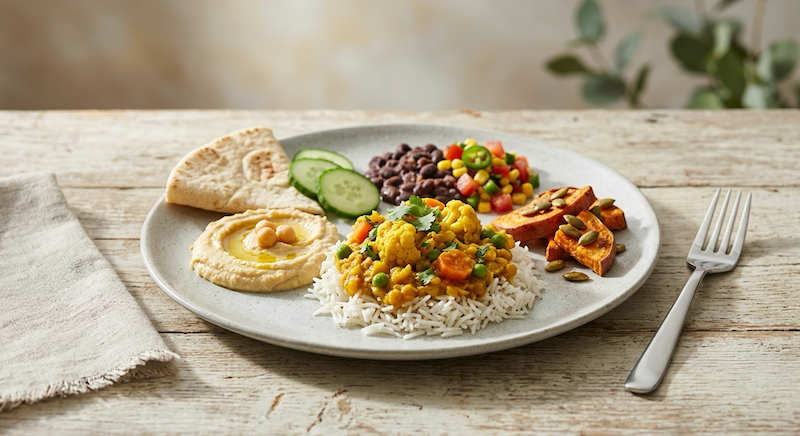
India has the most vegetarians in the world, both as a share of its population and in absolute numbers. In a large Pew Research Center survey, 39% of Indian adults said they considered themselves vegetarian.1 Applied to India’s population of about 1.48 billion in 2026, that gives roughly 577 million vegetarians. The number is an approximation, since the survey only covered adults and the two figures come from different years, but it shows the scale.
Ranking every other country is harder. No single survey asks the same question in every country, so the figures below come from separate national studies. They differ in the wording of the question, the age of the people surveyed and the year they were carried out. Most of them rely on self-identification: people say whether they consider themselves vegetarian, and nobody checks what they actually eat.2
If you are unsure about the difference between vegetarian, vegan or pescatarian, our guide to dietary patterns explains each one.
Vegetarians and vegans by country
The countries are ordered by the percentage of people who say they are vegetarian. The last column counts people who are either vegetarian or vegan. Flexitarians and pescatarians are left out.
| Country | Vegetarian | Vegan | Vegetarian or vegan |
|---|---|---|---|
| India | 39% | n/a | n/a |
| Brazil | 8% | n/a | n/a |
| Germany | 7% | 2% | 9% |
| United Kingdom | 6% | 2% | 8% |
| Italy | 5.3% | 3.2% | 8.5% |
| United States | 5% | 2% | 5-7% |
| Japan | 4.5% | 2.4% | 5.9% |
| Spain | 1.5% | 0.5% | 2% |
| Russia | 1% | n/a | n/a |
| France | 0.8% | 0.3% | 1.1% |
“n/a” means the source did not give a separate figure we could use. There are of course vegans in India, Brazil and Russia, the surveys just did not measure them the same way.
Why the United States shows a range
Gallup found that 5% of American adults identify as vegetarian and 2% as vegan. Adding the two gives 7%, but Gallup asked both questions separately and did not say how many people answered yes to both. The real combined share is somewhere between 5% and 7%.3
Japan shows why this matters. In the Vegewel survey, people could pick both labels. 4.5% picked vegetarian and 2.4% picked vegan, and the combined share was 5.9% instead of 6.9%, because some people chose both.4
Which country has the largest number of vegetarians?
India again, by far. With 39% of adults identifying as vegetarian in the most populous country on earth, India has more vegetarians than all the other countries in this table combined.
Ranking the other countries by headcount would be misleading. You would have to multiply percentages from surveys of different years and age groups by today’s total population, which includes children. Some studies do publish their own estimates. The Lantern study in Spain, for example, estimates about 620,000 vegetarian adults and 200,000 vegan adults in the country.5
As for the total number of vegetarians in the world, nobody really knows. A 2026 review looked at hundreds of national surveys across 58 countries and concluded that definitions and coverage varied too much to produce a reliable global figure.2
What about the rest of us?
Outside India, vegetarians are a minority everywhere in this table, usually between 1% and 8% of the population. In US, the share is between 5 to 7%. That can make going vegetarian feel isolating, especially at family meals or in restaurants. If you are thinking about making the switch, these 10 tips to go vegetarian cover the practical side, from planning meals to handling social situations.
And if you want to know what your choice changes, we calculated how many animals you save by eating vegetarian over a year.
Sources and methodology
We used the original surveys or the institutions that commissioned them whenever possible, rather than figures copied from ranking websites. Each percentage applies to the population surveyed in that study, and the surveys were carried out in different years, so small gaps between countries do not mean much.
- India: Pew Research Center surveyed Indian adults in 2019 and 2020 and asked whether they considered themselves vegetarian. People answered based on their own definition of the word.1
- Brazil: The 2018 IBOPE survey for the Sociedade Vegetariana Brasileira is often quoted as showing 14% vegetarians. We used the 8% who fully agreed with the statement “I am vegetarian” and left out the 6% who only partly agreed.6
- Germany: The federal agriculture ministry’s 2025 Ernährungsreport covers people aged 14 and over and reports vegetarians and vegans separately.7
- United Kingdom: YouGov’s Food Study, published in 2022, found that 6% of Britons describe themselves as vegetarian and a further 2% as vegan.8
- Italy: Eurispes’ Rapporto Italia 2026 reports 5.3% vegetarians, 3.2% vegans and 8.5% combined.9
- United States: Gallup’s July 2026 poll asked American adults two separate yes/no questions about being vegetarian and being vegan.3
- Japan: Vegewel’s January 2023 survey covered people aged 20 and over. Respondents could choose several answers, and the 5.9% combined figure accounts for that.4
- Spain: Lantern’s The Green Revolution 2025 covers the adult population. The headcounts quoted above come from the study itself.5
- Russia: The Russian Public Opinion Research Center (WCIOM) found in 2023 that 1% of respondents considered themselves vegetarian. The survey did not give a comparable vegan figure.10
- France: The Ifop study for FranceAgriMer surveyed people aged 15 to 70 and found 0.8% vegetarians and 0.3% vegans. It also counted 1.1% pescatarians, who are left out of our total.11
Footnotes
Pew Research Center, “Eight-in-Ten Indians Limit Meat in Their Diets, and Four-in-Ten Consider Themselves Vegetarian” (2021). https://www.pewresearch.org/short-reads/2021/07/08/eight-in-ten-indians-limit-meat-in-their-diets-and-four-in-ten-consider-themselves-vegetarian/ ↩ ↩2
2026 review of nationally representative dietary surveys across 58 countries. ↩ ↩2
Gallup (July 2026). https://news.gallup.com/poll/713645/marijuana-smoking-record-high-cigarettes-low.aspx ↩ ↩2
Vegewel (January 2023). https://vegewel.com/ja/style/statistics3 ↩ ↩2
Lantern, The Green Revolution 2025. https://www.lantern.es/blog/el-movimiento-plant-based-en-espana-entre-la-consolidacion-y-los-nuevos-retos ↩ ↩2
IBOPE for the Sociedade Vegetariana Brasileira (2018). https://svb.org.br/pesquisa-do-ibope-aponta-crescimento-historico-no-numero-de-vegetarianos-no-brasil/ ↩
German Federal Ministry of Food and Agriculture, forsa Ernährungsreport 2025 tables. https://www.bmleh.de/SharedDocs/Downloads/DE/_Ernaehrung/forsa-ernaehrungsreport-2025-tabellen.pdf?__blob=publicationFile&v=2 ↩
YouGov Food Study (2022). https://yougov.com/en-gb/articles/41668-part-one-general-attitudes-towards-food-and-eating ↩
Eurispes, Rapporto Italia 2026. https://eurispes.eu/news/rapporto-italia-2026-comunicato-stampa-sintesi/ ↩
WCIOM (2023). https://wciom.com/press-release/vegeterianism-and-veganism-pro-et-contra ↩
Ifop for FranceAgriMer (2020). https://www.franceagrimer.fr/chiffre-et-analyses-economiques/vegetariens-et-flexitariens-en-france-en-2020 ↩
About the Author

Founder of Goodbye Meat